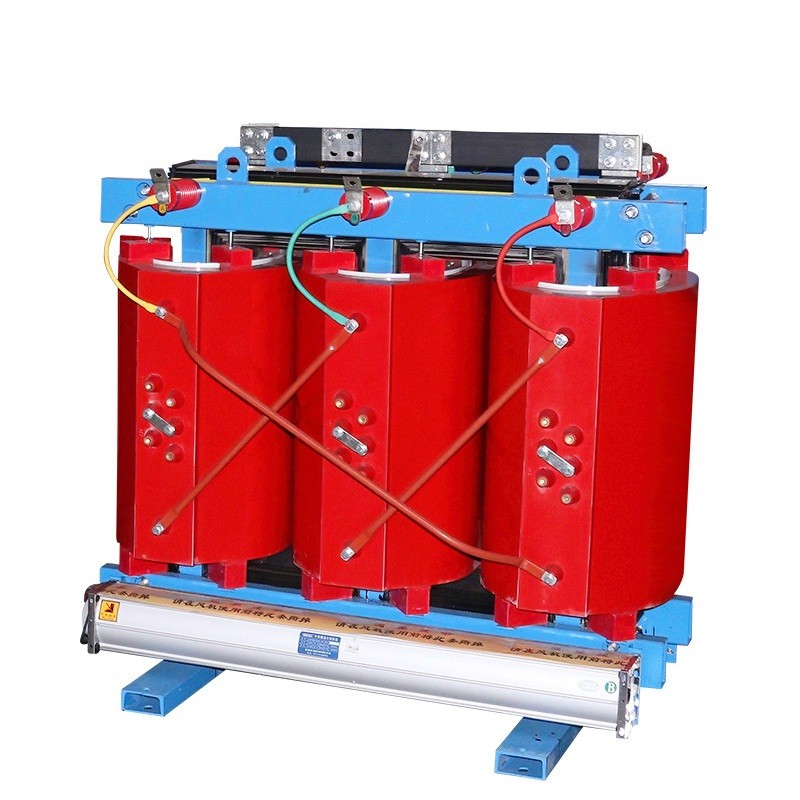
Cast-resin dry-type transformer at level-1 (NX1) efficiency — the indoor workhorse for buildings, data centres and indoor substations where fire risk has to be minimized.
Dry-type transformers are specified wherever an oil-filled unit is unacceptable: high-rise buildings, hospitals, data centres, underground rooms and metro stations. The SCB18 combines that safety profile with the highest efficiency class currently defined under the Chinese national standard.
The SCB18 is a three-phase epoxy resin cast dry-type transformer. The winding is vacuum cast in epoxy, which gives a solid insulation system with no oil and no liquid to contain. The low-voltage winding uses copper foil with a thin insulation layer, which improves short-circuit withstand and reduces harmonic losses. SCB18 sits at level-1 (NX1) efficiency under GB 20052-2024, the current highest energy efficiency class.
Primary voltage is applied to the high-voltage winding and a flux is created in the laminated core; the induced secondary voltage is taken from the foil winding and fed to the low-voltage busbar. Because there is no oil, cooling is by air: natural convection (AN) at normal load, or forced air (AF) with fans and a temperature controller for higher load rates. The temperature controller acts on PT100 sensors in the windings and can raise an alarm or trip the fans at preset levels.
| Parameter | Typical value |
|---|---|
| Rated power | 30 / 50 / 80 / 100 / 125 / 160 / 200 / 250 / 315 / 400 / 500 / 630 / 800 / 1000 / 1250 / 1600 / 2000 / 2500 kVA |
| High voltage | 6 / 6.3 / 10 / 10.5 / 11 kV |
| Low voltage | 0.4 kV (0.23 / 0.415 / 0.69 kV on request) |
| Rated frequency | 50 Hz / 60 Hz |
| Vector group | Dyn11 as standard, Yyn0 available |
| Short-circuit impedance (dry type) | 4% up to 630 kVA, 6% from 800 kVA |
| Efficiency class | Level 1 (NX1) per GB 20052-2024 |
| No-load loss P0 (630 kVA) | 0.750 kW |
| Load loss Pk at 120 °C (630 kVA) | 5.365 kW |
| Cooling | AN natural cooling, AF forced air on request |
| Enclosure protection | IP00 bare unit, IP20 standard, IP23 for dusty indoor, IP54 outdoor kiosk |
| Insulation class | F class (H class on request) |
| Partial discharge | Typically 10 pC or below |
| Ambient temperature | -5 °C to +40 °C |
| Compliance | GB 20052-2024, GB/T 10228-2023, GB/T 1094 series |
Size the unit on the calculated load with roughly 10 to 20 percent headroom for future growth, then check the impedance against the network so the fault level at the secondary busbar stays within the withstand rating of the downstream LV equipment. For a building, decide dry-type versus oil-type first: if fire rating or indoor siting decides it, the SCB18 is the only sensible dry-type choice, and if capacity exceeds about 2500 kVA the comparison usually shifts towards oil-immersed or a hybrid solution. Finally, confirm the efficiency class against the local energy cost — at level 1 the extra capital cost is recovered faster in high-tariff or high-load-rate installations.
SCB18-630/10 is a 630 kVA, 10 kV cast-resin dry-type transformer. Under GB 20052-2024 level-1 limits its no-load loss is 0.750 kW and its load loss at 120 °C reference temperature is 5.365 kW, with a short-circuit impedance of 6% at this capacity.
Level 1, which the GB 20052-2024 standard maps to NX1. SCB14 corresponds to level 2 and SCB13 to level 3.
With an IP54 outdoor enclosure it can be installed outdoors, including in package substation kiosks. The bare unit is IP00 and the standard indoor enclosure is IP20; IP23 is used for dusty indoor locations.
A dry-type unit has no oil, so it has no fire load and needs no oil-level or oil-quality inspection, which makes it the default choice indoors. An oil-immersed unit is cheaper per kVA, has a longer design life and handles very large capacities better, and it is the normal choice outdoors and in package substations.
Yes. Forced-air cooling (AF) with PT100 winding sensors and a temperature controller that raises an alarm and can trip the fans at preset levels is available as a standard option.
The routine factory test report with the actual no-load and load losses, the nameplate data, the approved outline drawing and the operation and maintenance manual.
10 days for standard ratings and 15 days for non-standard ratios or impedances, counted from deposit plus confirmed technical agreement plus approved drawing. MOQ is 1 unit.
Send us the rated voltage, rated current or capacity, quantity and destination country, plus any single-line diagram. We reply with a configuration proposal and a quotation — usually within 24 hours of receiving complete technical information.
Request a Quotation+86 186 5877 2666
Official page coming soon
sw@xsdq.cc
+86 186 5877 2666