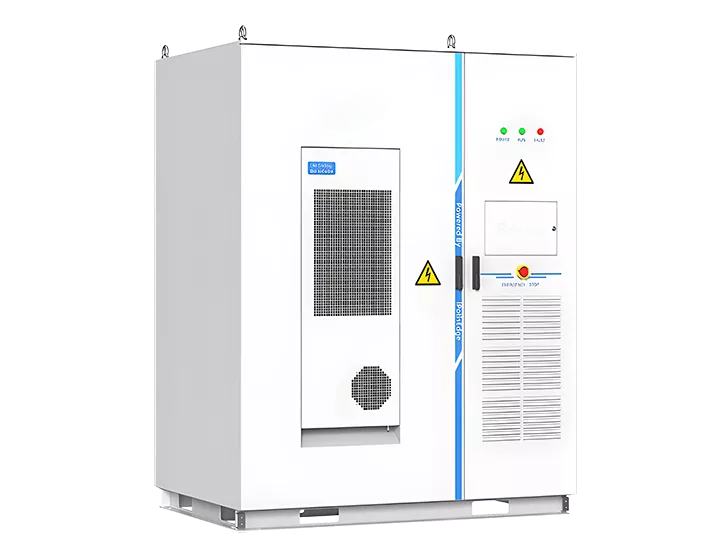
A static var generator cabinet that compensates reactive power in milliseconds — the answer for fluctuating loads where a fixed capacitor bank cannot keep up.
Capacitor banks and SVG solve the same problem in different ways. A capacitor bank is cheaper and losses-free at steady state, and it is the right choice for stable loads. An SVG costs more and has slightly higher losses, but it holds the power factor through load swings that would push a stepped bank into over-compensation or leave it lagging.
An SVG — static var generator — is a shunt-connected dynamic reactive power compensation device. An IGBT inverter inside the cabinet generates a controllable reactive current, so the output can be varied continuously and reversed within milliseconds. A fixed capacitor bank, by contrast, steps in discrete stages and cannot follow a rapidly changing load, which is exactly the situation in welding shops, rolling mills, hoists and large inverter installations.
The controller measures the voltage and the current on the incoming busbar, calculates the reactive power and the power factor in real time, and drives the IGBT inverter to inject the compensating current into the busbar. Because the compensation is continuous rather than stepped, the power factor can be held at the set point through load swings. For harmonic-heavy loads, a detuned reactor can be added to the network so that the compensation does not resonate with the existing harmonics.
| Parameter | Typical value |
|---|---|
| Rated voltage | 0.4 kV, 3-phase, 50 / 60 Hz |
| SVG rating | 50 / 100 / 150 / 200 / 250 / 300 / 400 / 500 kvar, continuous |
| Response time | Within milliseconds |
| Control mode | Power factor or reactive power set point |
| Target power factor | 0.95 to 0.99, user set |
| Overload capability | Capable of 1.1 times rated current for a limited period |
| Output voltage | Low-voltage output, connected to the LV busbar |
| Cooling | Forced air, with temperature-controlled fans |
| Protection class | IP30 indoor |
| Harmonic handling | Optional detuned reactor at 5.6% / 7% / 14% tuning |
| Compliance | IEC 61439, IEC 62477 for the static var generator, IEC 60831 for capacitors |
Values shown are typical ratings for this product family. Final ratings, dimensions and component selection are confirmed in the technical agreement and the order drawing; routine factory test reports are supplied with each unit.
Choose between the capacitor bank and the SVG by looking at how the load actually varies: if the reactive demand is steady across the shift, a capacitor bank is cheaper and simpler; if it swings within seconds — welding, hoisting, large inverter ramps — only a continuous device can hold the set point without over-compensation. Then size against the actual reactive power, not the apparent power, and add the detuned reactor when the harmonic content is high, because a compensator that resonates with the load is worse than no compensator at all.
Use a capacitor bank for stable, slow-varying loads. Use an SVG for fast fluctuating loads such as welding machines, rolling mills, hoists and PV inverters, where the SVG responds in milliseconds while a stepped bank would either lag or over-compensate.
Capacitor banks from 30 to 600 kvar and SVG cabinets from 50 to 500 kvar. Larger requirements are built as parallel banks.
Yes. For rectifier and VFD loads we add detuned reactors at 5.6%, 7% or 14% tuning to prevent harmonic resonance between the compensator and the network.
A capacitor bank has essentially no losses at steady state, while an SVG has switching and conduction losses of roughly 0.5% to 1% of rated output. This is why a bank is preferred for steady loads.
Yes. The control mode, the set point and the alarm outputs can be integrated with the building management system or the plant SCADA, and the reactive power and power factor can be read remotely.
IEC 61439 for the assembly, IEC 62477 for the static var generator and IEC 60831 for the capacitor components, alongside GB/T 15576-2020 for low-voltage reactive compensation assemblies.
15 days for customized compensation systems, counted from deposit plus confirmed technical agreement plus approved drawing.
Send us the rated voltage, rated current or capacity, quantity and destination country, plus any single-line diagram. We reply with a configuration proposal and a quotation — usually within 24 hours of receiving complete technical information.
Request a Quotation+86 186 5877 2666
Official page coming soon
sw@xsdq.cc
+86 186 5877 2666